When and how to use breathy vocals?
- Posted on

Norah Jones – Don’t Know Why, Billie Eilish – When the Party’s Over, and Adele – Easy On Me (verses), all share one subtle but defining vocal characteristic: breathiness. Letting air pass through the vocal tone instead of aiming for full projection helps create a soft, intimate quality that draws the listener closer.
This sense of closeness has become a powerful tool in contemporary music. It changes the emotional framing of a performance. It really turns the spotlight on the person, the vulnerability of the singer. And it can be a super effective tool to zoom in on the emotion during a verse, create contrast, and then come back to full voice for the chorus.
Breathy singing is technically demanding for vocalists. Letting excess air pass through the voice creates several difficulties:
- Maintaining pitch is harder because the vocal folds, being more relaxed to allow breathiness, offer less resistance to airflow, making the tone less stable.
- Breath support must be carefully controlled to avoid running out mid-phrase.
- Multiple vocal takes are often needed to get emotional delivery and vocal precision.
For the recording engineer, this kind of vocal brings additional challenges: mouth noise, exaggerated sibilance, and sudden dynamic shifts become more prominent. Managing these artifacts without losing the intimacy of the performance requires careful gain staging and subtle processing.
How the Vocal Studio Breath Algorithm Works?
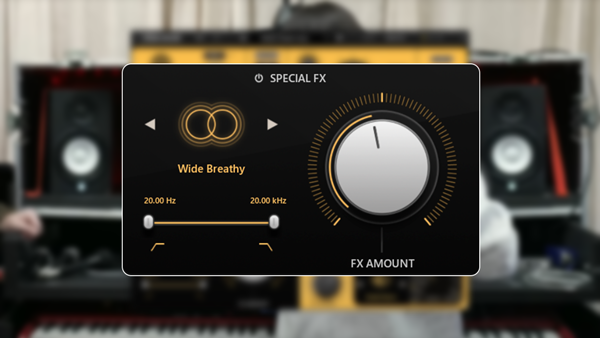
Pulsar Vocal Studio features an algorithm designed to synthesize noisy textures that replicate the breathy quality of vocals without needing to re-record the performance. Here’s a brief explanation of its operation:
When air passes through the vocal folds without complete closure, it generates noise (primarily in frequencies above 4 kHz) resulting in less defined overtones in this range. This noise is then further shaped by the resonances of the mouth, larynx, nasal cavities, and other vocal tract components, filtering it according to the voice’s formants.
Our algorithm generates noise spectrally shaped to follow these vocal formants. Although the underlying math is complex to achieve a natural and convincing timbre and timing, it can be roughly understood as a vocoder, the vocal signal acts as the modulator, and the shaped noise serves as the carrier.
![[IPA 25] How We Matched the Original Hardware - Without Burning Your CPU](https://pulsar.audio/wp-content/uploads/2025/09/Thumbnail-IPA25-Video-2-150x150.jpg)